How to Find Reliable Used Cars Without Overpaying
Buying a used car can be a smart financial decision, but it also comes with risks. Unlike new cars, used vehicles vary significantly in condition, maintenance history, and long-term reliability. Many buyers focus only on price and later discover hidden repair costs that exceed their expectations.
Buying a used car can be a smart financial decision, but it also comes with risks. Unlike new cars, used vehicles vary significantly in condition, maintenance history, and long-term reliability. Many buyers focus only on price and later discover hidden repair costs that exceed their expectations.
A better approach is to evaluate a used car based on total ownership value, not just the upfront price.
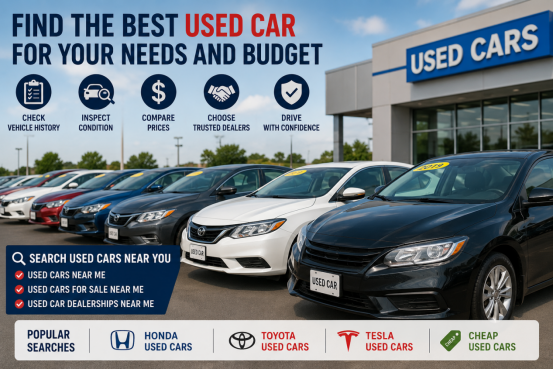
Common Mistakes Used Car Buyers Make
Many buyers fall into the same traps:
Focusing only on the lowest price
A cheaper car is not always a better deal. Low prices often hide issues such as engine wear, accident history, or poor maintenance.
Ignoring accident history
Even if a car looks clean externally, structural damage can affect safety and long-term durability.
Judging by appearance only
Exterior condition does not reflect mechanical health. Key systems like the engine, transmission, and suspension matter more.
Key Evaluation Factors Before Buying
Before making a decision, always evaluate:
- Vehicle history report (accidents, flooding, ownership changes)
- Mileage vs. age consistency
- Engine and transmission condition
- Maintenance records
- Long-term repair and ownership costs
- Market resale value
Among these, reliability and maintenance cost usually matter more than purchase price.
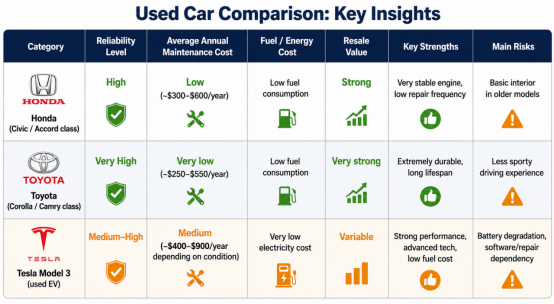
Mainstream Used Car Comparison (Market-Based Reference Data)
The table below summarizes typical market behavior and long-term ownership characteristics based on widely observed used car industry data patterns (not tied to a single vehicle).
How to Inspect a Used Car Properly
When physically checking a vehicle, focus on:
Vehicle history report
Look for:
- Major accidents
- Flood damage
- Salvage title
- Frequent ownership changes
Mileage consistency
Red flags include:
- Very low mileage for an old car
- Wear level inconsistent with reported usage
Test drive evaluation
Pay attention to:
- Smooth acceleration
- Transmission shifting quality
- Brake response
- Steering alignment
- Unusual noises
Maintenance records
A complete service history usually indicates better long-term reliability.
Smart Buying Strategy Based on Budget
Low Budget Buyers
Focus on:
- Reliable, simple mechanical structure
- Proven long-life models
- Reasonable mileage
Goal: basic transportation with minimal risk
Mid Budget Buyers
Focus on:
- Balanced comfort and reliability
- Newer model years
- Better safety features
Goal: daily usability + comfort
High Budget Buyers
Focus on:
- Electric vehicles or premium brands
- Technology and performance
- Lower long-term fuel cost
Goal: driving experience and efficiency
Think in Terms of Total Ownership Cost
A smarter way to evaluate a used car is:
Total Cost = Purchase Price + Maintenance + Fuel/Energy + Depreciation
For example:
- A cheap car may require frequent repairs, increasing total cost over time
- A slightly more expensive but reliable car may actually be cheaper in the long run
Conclusion
Choosing a used car is not about finding the cheapest option—it is about finding the best balance between reliability, cost, and long-term value.
If you focus on:
- Proven brands (Honda, Toyota)
- Transparent vehicle history
- Consistent maintenance records
- Reasonable mileage
You significantly reduce risk and increase the chances of getting a dependable vehicle.
How do you like this article?